
Split your study time into 25-minute focus blocks with 5-minute breaks, and take a longer break after three or four blocks. Give each block one clear goal, like “20 flashcards” or “past paper, question 3”, use active methods such as testing yourself instead of rereading, and keep your phone out of reach until the break.
Why it works for studying
- It beats procrastination. “One block of chemistry” is easy to start. “Study chemistry tonight” isn't.
- It keeps you fresh. Regular short breaks stop the slow slide into rereading the same page. In one study, university students who took fixed Pomodoro-style breaks felt less tired and more motivated than those who decided on breaks themselves, and got the same work done in less time.
- It makes progress visible. Four blocks done is something you can see, which helps on days when the material feels endless.
- It protects your evening. Planning in blocks tells you when you're done, so studying doesn't spread into the whole night.
Plan your session in blocks
- List what you need to cover. Topics, chapters, problem sets, essays.
- Estimate blocks, not hours. “Two blocks for chapter 4, one for the problem set.”
- Put the hardest thing first, while your head is fresh.
- Give every block a goal you can tick off: a section, a set of questions, a page of notes.
- Keep the last block for review: test yourself on what you did today.
What to do in each block
A block is only as good as what you do in it. Research on study techniques consistently finds that testing yourself and spreading practice over time work far better than rereading or highlighting (Dunlosky and colleagues, 2013).
| Technique | What it looks like in a 25-minute block |
|---|---|
| Self-testing | Close the book and write down everything you remember, then check what you missed. |
| Practice questions | Work through past papers or end-of-chapter problems without looking at the answers. |
| Flashcards | Go through a deck, and put the ones you got wrong back in for the next block. |
| Explain it simply | Explain a concept out loud or on paper as if to a friend. Gaps show up quickly. |
| Spread it out | Come back to a topic over several days instead of doing it all in one sitting. |
Sample study schedules
These use 25-minute focus blocks, 5-minute short breaks and a 20-minute long break after every three blocks, the defaults in Pomodoro Focus. Adjust them to your day.
| Plan | How it goes | Total |
|---|---|---|
| Quick review | Focus · break · focus, then a 5-minute self-test | About 1 hour |
| Homework evening | Focus · break · focus · break · focus · long break · focus | About 2½ hours |
| Exam revision day | Three sets of three blocks, each set followed by a long break, with lunch in the middle | 9 blocks, about 6 hours with breaks |
| The night before | Two or three blocks of light self-testing, then sleep | About 1½ hours |
Too long or too short? If 25 minutes feels like a lot, start with 15 and build up. If you keep getting into a good flow, try 45 or 50 minutes with 10-minute breaks.
Breaks that actually help
Get up and move, drink some water, look out of a window, or have a snack. Avoid your phone's feeds: they're built to keep you scrolling, and they make starting the next block much harder. Long breaks are a good time for a walk or a meal.
Studying with background sound? Song lyrics tend to interfere with reading and memorizing. Steady sounds like rain usually work better: see our guide to focus sounds.
Track it by subject
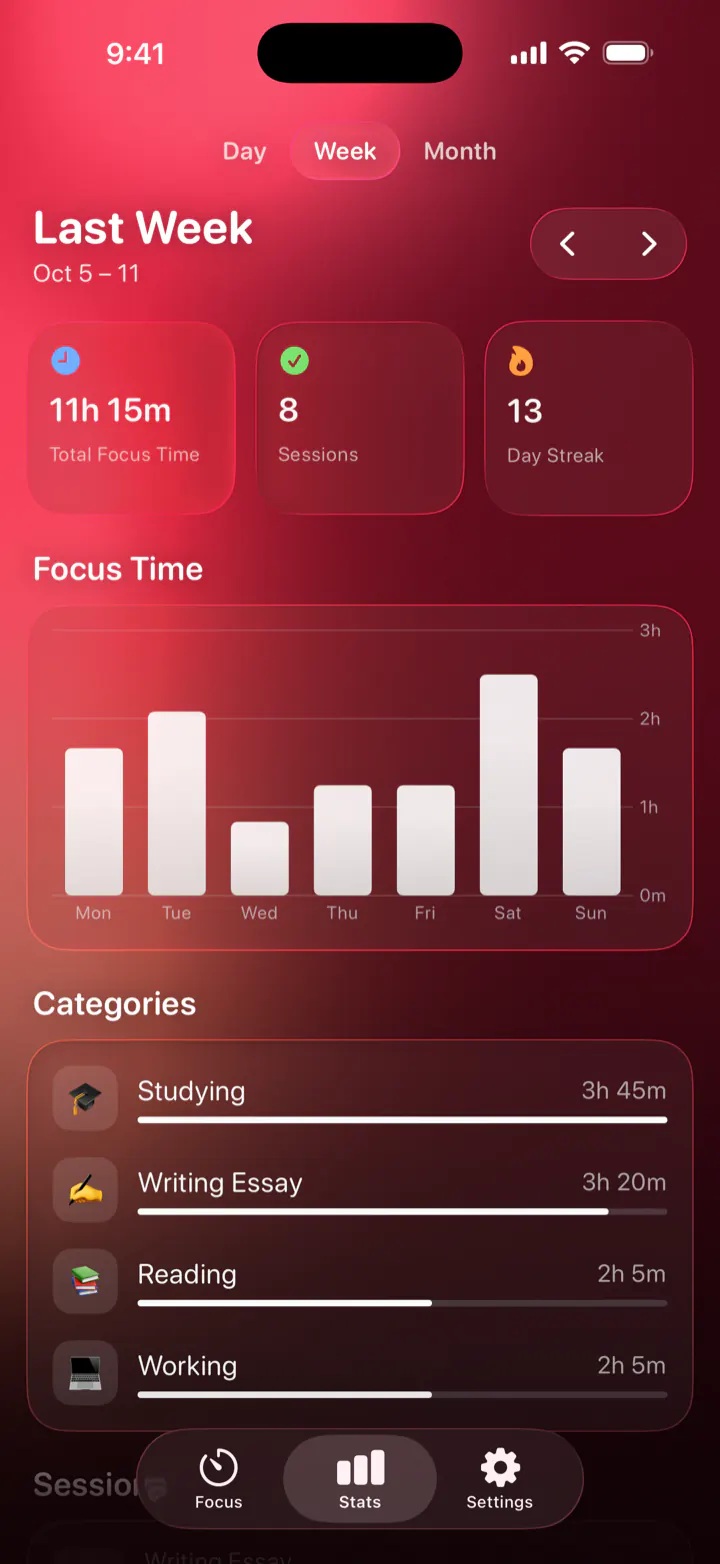
Seeing your study time adds up is one of the best motivators. In Pomodoro Focus you can make a category for each subject, like “Math 📐” or “Biology 🧬”, pick it before a block, and see in Stats how much time each one got this week. The day streak shows how many days in a row you've studied.
Questions
How many pomodoros should I study a day?
On a normal school or university day, 4 to 6 focused blocks on top of classes is a solid amount. In exam season, 8 to 12 blocks spread over the day is a lot, but doable with real breaks. Quality matters more than the count: one block of self-testing beats two of rereading.
Is 25 minutes too short for studying?
Not for most people. It's long enough for a set of practice questions or a section of notes. If you often get into a flow, try 45 or 50 minutes with 10-minute breaks.
Should I listen to music while studying?
Music with lyrics tends to get in the way of reading and memorizing, because your brain processes the words. Instrumental music or a steady sound like rain is less distracting for most people.
What should I do in a study break?
Get up and move, drink water, look at something far away. Avoid social feeds: they make it harder to start the next block.
Can the Pomodoro Technique help with procrastination?
Yes, that's what it's best at. Committing to one 25-minute block is much easier than committing to a whole evening of studying, and once you've started, carrying on is easier.
Sources
- Dunlosky, J., Rawson, K. A., Marsh, E. J., Nathan, M. J. and Willingham, D. T. (2013). Improving students' learning with effective learning techniques. Psychological Science in the Public Interest 14(1): 4–58.
- Biwer, F. et al. (2023). Understanding effort regulation: Comparing “Pomodoro” breaks and self-regulated breaks. British Journal of Educational Psychology 93: 353–367. doi:10.1111/bjep.12593