
The Pomodoro Technique is a time-management method. You pick one task, work on it for 25 minutes without interruptions, then take a 5-minute break. Each 25-minute session is called a pomodoro. After four pomodoros you take a longer break of 15 to 30 minutes. Francesco Cirillo came up with it in the late 1980s as a university student and named it after his tomato-shaped kitchen timer: pomodoro is Italian for tomato.
How to do it, step by step
All you need is a list of tasks and a timer. One full round of four pomodoros with breaks takes about two hours.
- Choose one task
Decide what you'll work on and write it down. Split big tasks into pieces: “write the introduction” works better than “write the essay”.
- Set a timer for 25 minutes
Silence notifications and put your phone face down, or out of reach. A Lock Screen timer lets you check the time without unlocking it.
- Work until the timer rings
Stay on that one task. If something else comes to mind, jot it down and get back to work. If you finish early, use the rest of the time to review what you did.
- Take a 5-minute break
Stand up, stretch, get some water or look out of the window. Stay away from email and social feeds, so the break is real rest.
- Repeat
Start the next pomodoro on the same task, or the next one on your list.
- Take a longer break after a few rounds
After four pomodoros (three in Pomodoro Focus), take 15 to 30 minutes off. Then start a new set.
Why it works
The method is simple, but it deals with three things that make focused work hard: getting started, staying on one thing, and running out of energy.
Starting gets easier
“Work on the report” is vague and endless. “Work on the report for 25 minutes” is small and concrete. A short, fixed commitment takes the edge off a task you've been avoiding, and once you've started, carrying on is much easier.
One thing at a time
Switching between tasks has a cost: every switch takes time and attention before you're back up to speed, as experiments on task switching have shown (Rubinstein, Meyer and Evans, 2001). A pomodoro gives you a protected block for a single task, and a place to park everything else until the break.
Breaks keep you fresh
Concentration wears down. A 2022 review of 22 studies found that short breaks of up to 10 minutes made people feel more energetic and less tired (Albulescu and colleagues, PLOS ONE). A 2023 study with university students compared fixed, Pomodoro-style breaks with breaks the students chose themselves: with fixed breaks they felt less tired and distracted and more motivated, and got the same amount of work done in less time (Biwer and colleagues, British Journal of Educational Psychology).
Time becomes visible
Counting pomodoros shows you how long things really take. “That chapter took six pomodoros” is useful information for planning the next one, and seeing the count grow during the day is motivating.
How long should a pomodoro be?
25 minutes is a starting point, not a rule. It's what worked for Cirillo, and it suits a lot of tasks, but it's worth adjusting to the work in front of you.
| Situation | Focus | Break |
|---|---|---|
| The classic method | 25 min | 5 min; 15–30 min after four |
| A task you've been putting off | 10–15 min | 3–5 min |
| Studying, reading, admin | 25–30 min | 5 min |
| Deep work: writing, coding, design | 45–50 min | 10 min |
| A flow session you don't want to cut short | Open-ended | When you stop |
If you often look up before the timer rings, try shorter sessions. If the timer keeps interrupting you in the middle of good work, try longer ones. In Pomodoro Focus, focus can be anything from 10 to 90 minutes, short breaks 1 to 15 minutes and long breaks 10 to 40 minutes.
What to do in your breaks
A good break gives your attention a rest. The easiest test: would you happily stop doing it after five minutes?
- Move: stand up, stretch, walk to the kitchen, do a few squats.
- Rest your eyes: look at something far away, out of a window if you can.
- Look after yourself: drink water, have a snack, open a window.
- Tidy up: clear your desk, refill your bottle, write down the next small step.
Social media, news and email are the worst break activities: they're designed to hold your attention, so five minutes easily turns into twenty, and they leave your head full of other things.
Long breaks are for real rest: a walk, a meal, a chat with someone, or a short nap.
Common mistakes
- Skipping breaks because you feel fine. Fatigue builds up quietly. Take the break, especially the long one. If you're truly in the zone, switch to an open-ended session instead of skipping breaks all day.
- Letting a pomodoro break into pieces. In Cirillo's method a pomodoro is indivisible. If you have to stop for something real, end it and start a fresh one later.
- Tasks that are too big. If something takes more than five or six pomodoros, split it into smaller tasks.
- Keeping the phone in your hand. Put it face down or out of reach, and use a timer you can see without unlocking it.
- Treating the numbers as sacred. 25 and 5 are defaults. Change them until the rhythm feels right.
Doing it with Pomodoro Focus
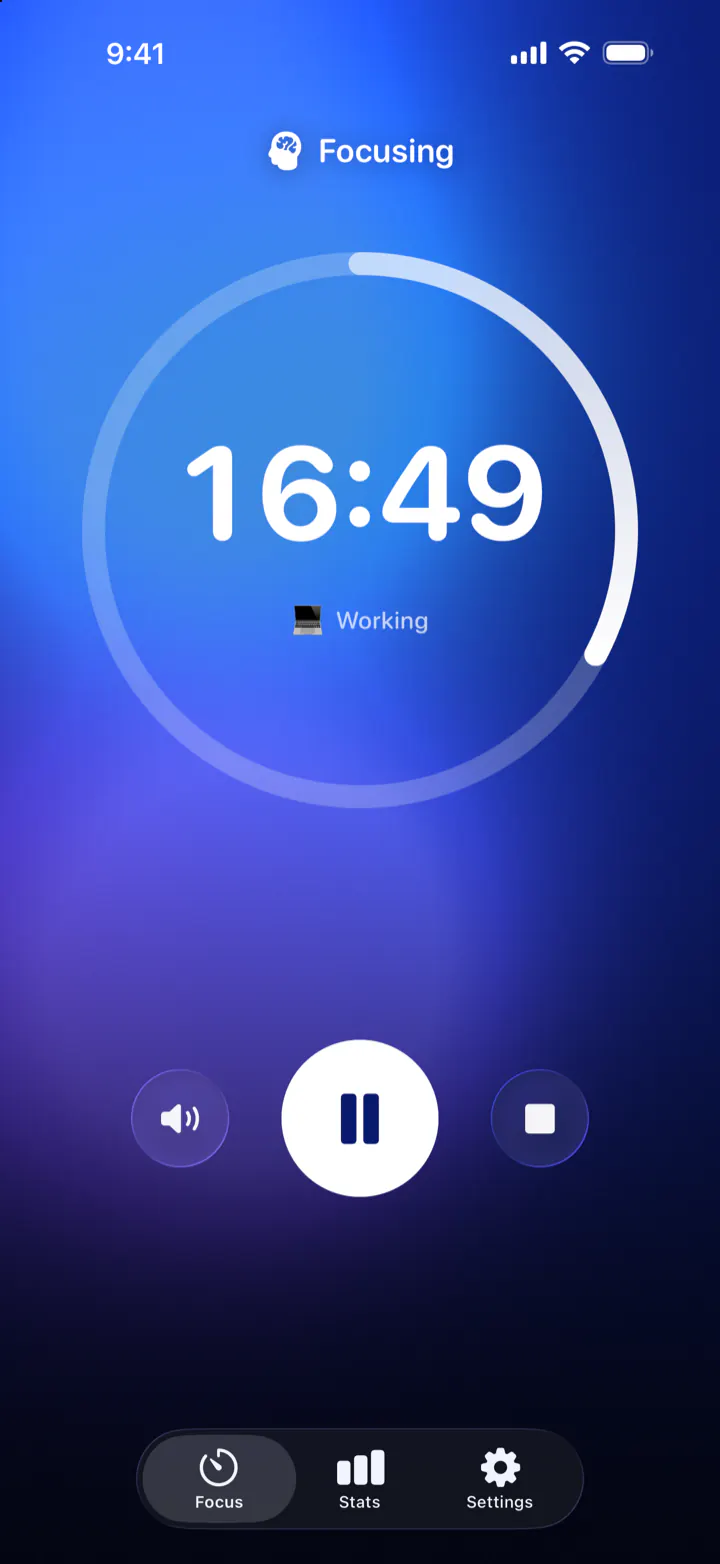
Pomodoro Focus is a free iPhone and iPad app that runs the whole cycle for you:
- Open the app, choose Pomodoro at the top of the screen, and pick what you're focusing on, like Studying, Working or Reading.
- Press start and lock your phone. The countdown stays on the Lock Screen and in the Dynamic Island.
- When the focus ends, you get a notification and your short break is ready: start it with one tap from the notification, the Lock Screen or the app.
- After every 3 focus sessions the app gives you a long break.
- Your focus time, sessions and day streak show up in Stats.
Questions
Why is a pomodoro 25 minutes?
It's the length Francesco Cirillo found worked best for him: long enough to make real progress, short enough to stay focused and to start without dread. There's nothing magic about it, and many people do better with 30, 45 or 50 minutes.
How many pomodoros should I do in a day?
It depends on your work. Many people find that 6 to 10 pomodoros, roughly 3 to 4 hours of real focus, make a full day of deep work, with meetings and small tasks around them. Start with a few and see what you can keep up.
What if I get interrupted?
If it can wait, write it down and keep going. If you really have to stop, end the pomodoro and start a fresh one when you're back: in Cirillo's method a pomodoro is indivisible.
Does the Pomodoro Technique work for ADHD?
Many people with ADHD say short, timed sessions make tasks easier to start and to stick with, and that regular breaks help. There's little research on the technique itself, so treat it as an experiment: try shorter sessions, like 10 to 15 minutes, and adjust from there.
What's the difference between a short and a long break?
Short breaks, usually 5 minutes, come after every focus session and are for a quick reset. A long break of 15 to 30 minutes comes after a set of sessions, traditionally four, and is for real rest.
Do I need a special timer?
No, any timer works. An app made for it helps, because it runs the cycle for you, reminds you to take breaks and keeps a record. Pomodoro Focus is free and keeps the countdown on your Lock Screen.
Sources
- Francesco Cirillo, The Pomodoro Technique.
- Albulescu, P. et al. (2022). “Give me a break!” A systematic review and meta-analysis on the efficacy of micro-breaks for increasing well-being and performance. PLOS ONE 17(8): e0272460. doi:10.1371/journal.pone.0272460
- Biwer, F., Wiradhany, W., oude Egbrink, M. G. A. and de Bruin, A. B. H. (2023). Understanding effort regulation: Comparing “Pomodoro” breaks and self-regulated breaks. British Journal of Educational Psychology 93: 353–367. doi:10.1111/bjep.12593
- Rubinstein, J. S., Meyer, D. E. and Evans, J. E. (2001). Executive control of cognitive processes in task switching. Journal of Experimental Psychology: Human Perception and Performance 27(4): 763–797.